
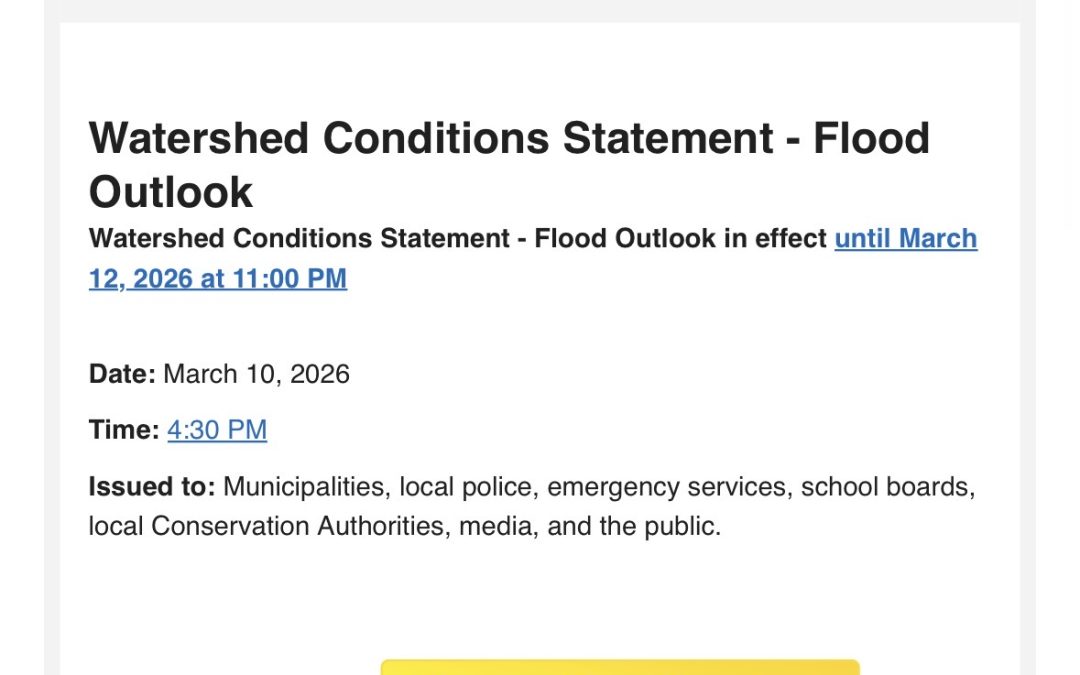
Watershed Conditions Statement – Flood Outlook in effect until March 12, 2026 at 11:00 PM
Date: March 10, 2026
Time: 4:30 PM
Issued To: Municipalities, local police, emergency services, school boards, local Conservation Authorities, media, and the public.
Note: A Flood Outlook Watershed Conditions Statement is an early notice of the potential for flooding based on weather forecasts calling for conditions that could lead to high runoff and cause ice jams or lakeshore flooding.
Weather Conditions:
Toronto and Region Conservation Authority (TRCA) advises that Environment and Climate Change Canada (ECCC) have issued a yellow level warning – rainfall for a weather system that is expected to bring warm air temperatures and 20 to 40 mm amounts of rainfall to all of TRCA watersheds and across the entire Greater Toronto Area.
Rain and warm air temperature are forecasted to begin this afternoon and continue throughout tomorrow evening. Non severe thunderstorms are possible on Wednesday March 11.
Issues:
Current weather forecasts show a higher risk of flooding in TRCA rivers as rain, warm air, melting snow, and ice may raise water levels and cause ice jams throughout tomorrow. Ice jam risk mainly exists for northern GTA.
All shorelines, rivers, and streams in TRCA jurisdiction should be considered dangerous as this rainfall may cause rapidly changing water levels and stronger and faster flows in TRCA rivers. River ice may also break up, move and accumulate in some areas and that could lead to flooding.
The ground in TRCA watersheds is partly frozen. This stops rain and melted snow from soaking in and makes more water run into rivers. This could cause flooding in flood plains and in low-lying areas that do not drain well.
Actions:
Stay safe around water by avoiding rivers and riverbanks, shorelines, and nearby trails. Keep children and pets away from fast moving water and slippery or unstable riverbanks and consider postponing recreational activities on frozen surfaces due to these hazards until conditions improve.
Travel with caution by allowing extra time for commuting. Never drive, walk, or bike through floodwater since water can be deeper or faster than it looks, and watch for ponding in low-lying areas and underpasses, or near storm drains. Follow all detour and road closure signage.
Stay informed by following local weather forecasts, and public alerts from Environment Canada.
Share flood safety information by keeping neighbors informed, especially those without internet access.
Municipalities and emergency services should consider reviewing flood preparedness protocols and increase monitoring in known flood vulnerable areas for changing conditions.
For more information please contact the on-call Flood Duty Officer.
Flood Duty Officer
Mohammad Semnani
416-661-6514
Chief Flood Duty Officer
Matthew Kuyntjes
TRCA’s role during a flooding event is to monitor weather forecasts and watershed conditions, forecast for flooding conditions on river systems and the Lake Ontario shoreline, and notify municipalities and the public by issuing flood messages. Based on watershed knowledge, TRCA also provides technical advice to municipalities in support of their flood response efforts.