December 2025
Regional Council approved Peel Region’s 2026 Operating and Capital Budget with investments balanced between the needs of residents and businesses and the infrastructure requirements of the broader community.
Recognizing the affordability crisis, Peel Region’s Continuous Improvement Program achieved $8.1 million in cost savings and $3.4 million in cost avoidance during 2025. View the full Efficiencies, Service Improvements and Innovations 2025 report and Appendix.
In addition, through 4 days of deliberation, Peel Regional Council reduced the proposed property tax increase by 20%. The overall 2026 property tax impact for Peel Region services is 1.53%, Peel Regional Police 1.77% and other agencies 0.06% for a total average property tax increase of 3.36%.
The development of Peel Region’s 2026 Budget was anchored to Peel’s Strategic Plan and the community priorities recommended for consideration prior to the budget.
The 2026 Budget includes investments of $7.4 billion, making critical investments for Peel’s growing community to support population-driven service demand, build homes faster, develop deeply affordable housing, enhance community safety and well-being, keep Peel Region’s infrastructure assets in good repair, and manage the impacts of funding shortfalls.
Peel Service investments to support the needs of the community include:
- To build homes faster, a capital investment of $1.9 billion to support our backbone infrastructure, water supply and wastewater
- To address public safety, the addition of 175 officers and 25 civilian professionals to address historical underinvestment in staffing, regional growth (population, households, registered vehicles and calls to 9-1-1), growing community needs and demands, increasing complexity of crime and the commitment to community safety
- Investing $38 million for enhancements and state of good repair for ambulances, other paramedic fleet, and ambulance equipment
- Adding 40 paramedics to support a growing and aging population, increased call volumes, and to manage system pressures
- Investing $203.9 million in capital for state of good repair for Peel Living, Community Housing Providers loans, and Peel owned shelters and buildings
- Continuing to implement the Peel Community Housing Development Program with a capital investment of $16.5 million
- Ensuring safe and sustainable wraparound care at the Seniors Health and Wellness Village at Peel Manor with a $3.3 million investment
- Investments of $23 million for installation and upgrades of boilers, air conditioners, and HVAC systems at Sheridan Villa and Malton Village, and $2.5 million for tub and shower renovations at Tall Pines, and Malton Village
- A capital investment of $341.3 million for road construction, intersection improvements, and active transportation
- Coordinating a systems response to increased immigration and refugees in Peel and advocating for resources and greater coordination for Anti-Human Sex Trafficking supports
- Protecting residents from environmental hazards through programs and urgent response plans, and catching up on routine school immunization, and record screening and enforcement of the Immunization of School Pupils Act, 1990
A number of existing reports have documented how municipalities across Ontario are increasingly subsidizing services that are traditionally the responsibility of the provincial government. In many cases, provincial funding has not kept pace with inflation, population growth, or service demand, leaving municipalities to cover the shortfall through property taxes and other limited revenue sources. These reports help illustrate the broader fiscal imbalance between levels of government and underscore the financial pressures placed on municipalities as a result of downloading.
For example, the 2023 AMO pre-budget submission report (Page 3-4) has highlighted that Ontario municipalities subsidize the province by more than $5 billion in services under provincial jurisdiction. This information is compiled based on each municipality’s publicly available financial information return. Majority of these subsidies relate to Region of Peel’s human and health services, including community housing, social services, long term care, public health and ambulance services. The City of Mississauga past pre-budget submissions have also highlighted the City’s revenue shortfalls and the need for additional funding from senior levels of government. For example, the Hazel McCallion Light Rail Transit (LRT) is a provincial infrastructure project delivered by Metrolinx, but its operating costs are fully borne by the municipality. The 2025 pre-budget submission also highlighted Trillium Health Partners’ request for the City to subsidize the local share construction cost of the Peter Gilgan Mississauga Hospital, despite the tax burden on residents and the fact that hospital services are a provincial responsibility.
There are challenges with regards to implementing the resident’s proposed motion to publish annual and cumulative “unfunded downloaded costs” since 2000. First of all, both service responsibilities and provincial grant funding have evolved significantly over the past 25 years. Accurately identifying and quantifying what constitutes “downloaded services” during that time would require staff to apply substantial assumptions. Also, due to the City’s and the Region’s record retention policies, financial data from over 20 years ago may no longer be available or may be incomplete.
While we understand that the intent of this information is to support provincial funding advocacy, AMO and the City does already prepare annual reports outlining revenue funding shortfalls and other financial information for advocacy and public education purposes. We greatly value your feedback and will continue to review and consider improvements to our financial reporting to improve transparency wherever possible.
The 2026 police budget increase was reduced to 9.9%, which contributed to the lower regional tax increase. That said, Mississauga residents are still paying for 62% of the Peel regional police costs, while Brampton pays only 38%, even though Brampton has now exceeded Mississauga in population. We continue to advocate to the province to make changes to the regional police cost apportionment formula to further reduce the tax burden to Mississauga residents.
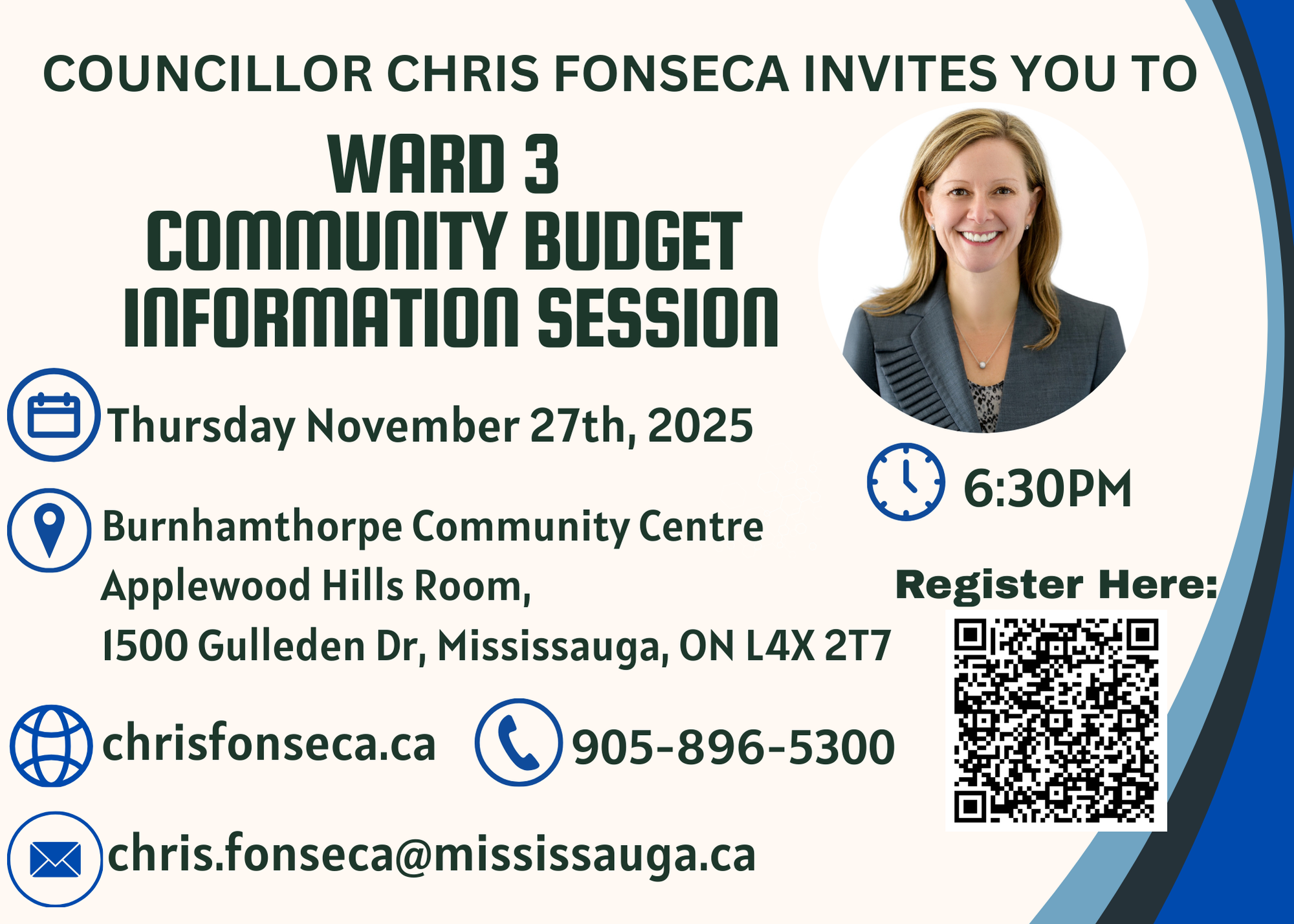
Since the summer, staff have been working closely with Mayor Parrish and the Budget Committee to solicit feedback from residents on the 2026 budget. Council members have held in-person ward budget townhalls to update residents on factors that could impact the 2026 budget as well as gather their feedback around budget priorities. The feedback received have been incorporated into the development of the proposed budget, which will be released on January 6, 2026. We encourage residents to participate at the upcoming Budget Committee meetings. Staff will be presenting the budget and delivering service area presentations on January 12, 2026 at 9:30am and January 13, 2026 at 2 timeslots – 9:30am and 6:00pm. Proposed Council budget amendments will be discussed at the January 28th Council meeting.”
November 20, 2025
Nishan Duraiappah, Lauren Jackson, and Alan Boughton, Peel Regional Police
———————————————————————————————————————————————————————————————————————————————————————————–
Highlights from day one of Peel’s 2026 Budget presentations
BRAMPTON, ON (Nov. 20, 2025) – Today at Regional Council, Peel’s 2026 Budget Overview was presented, along with the Peel Regional Police Budget.
The 2026 Budget Overview highlighted some of the challenges Peel is facing as a growing community with increased service demands.
The proposed 2026 Budget includes investments of $7.4 billion to maintain current service levels for a growing population, while addressing priority community needs.
Critical urgent needs being addressed include:
- Building homes faster – ensuring housing enabling infrastructure is in place
- Supporting population-driven service demand
- Enhancing community safety and well-being
- Keeping Peel’s infrastructure assets in good repair
- Developing deeply affordable housing
- Managing the impacts of funding shortfalls
To address the challenges being faced, the 2026 Budget also reflects $11.5 million in cost savings and in cost avoidance found through continuous improvement efforts and cost containment measures.
For the impact on the overall property tax, Peel Region services account for a 1.98% increase, Peel Regional Police a 2.16% increase and other agencies 0.06%.
Next steps and more information
- November 27, 2025: Presentations continue for Peel Region services.
- December 4, 2025: Presentations for 2 Regionally Financed External Organizations including Credit Valley Conservation Authority and Toronto and Region Conservation Authority.
- The Regional Council Budget meetings are open to the public and residents may attend. The meetings will also be live streamed.
- The 2026 Regional Operating and Capital Budget is available at peelregion.ca/budget.
—————————————————————————————————————————————————————————————————————————————————————————————-
Regional Council to begin deliberating Peel’s proposed 2026 Budget tomorrow
(Nov. 19, 2025) – Regional Council discussions of Peel’s 2026 Operating and Capital Budgets begin tomorrow morning at 9:30 a.m.
Budget presentations will be as follows:
- Nov. 20 – Presentation for Peel Regional Police followed by the Peel Budget Corporate Overview presentation.
- Nov. 27 – Presentations for select Peel Region Services.
- Dec. 4 – Presentations for Regionally Financed External Organizations: Credit Valley Conservation, and Toronto and Region Conservation Authority.
Visit the 2026 Budget page for more information and to view videos for services.
The Regional Council Budget meetings are open to the public and residents may attend. The meetings will also be live streamed on peelregion.ca.
The proposed 2026 Regional Operating and Capital Budget is available at peelregion.ca/budget.
——————————————————————————————————————————————————————————————————————————————————————————————-
Peel’s proposed 2026 Budget now available
BRAMPTON, ON (November 13, 2025) – Peel’s proposed 2026 Budget is now available at peelregion.ca/budget. Regional Council discussions of the Operating and Capital Budgets begin on Thurs., Nov. 20 at 9:30 am with a presentation by Peel Regional Police.
The development of Peel’s 2026 proposed Budget was anchored to our Strategic Plan and the community priorities recommended for consideration prior to the budget.
The proposed 2026 Budget includes investments of $7.4 billion, making critical investments for our growing community to support population-driven service demand, build homes faster, develop deeply affordable housing, enhance community safety and well-being, keep Peel Region’s infrastructure assets in good repair, and manage the impacts of funding shortfalls. Additionally, there are enhanced investments in paramedic services, seniors services, and public health, and many other necessary programs with a high social impact that Peel supports and delivers.
Additional Resources
- The Regional Council Budget meetings are open to the public and residents may attend. The meetings will also be live streamed at peelregion.ca/council/video
- Anyone wishing to make representation to Regional Council should email their submission or request to delegate to the Office of the Regional Clerk at regional.clerk@peelregion.ca or call 905–791–7800, ext. 4545, at least 72 hours prior to the budget meeting (i.e. by 9:30 a.m. on the Monday prior to the meeting), please visit the delegation guide at peelregion.ca/council/guide-for-delegations.asp
- More information can be found at peelregion.ca/budget
———————————————————————————————————————————————————————————————————————————————————————————————